
文质彬彬·每日好词语|比显兴隐
发稿时间:2026-11-29 06:38:00 来源: 中国青年报
整理/蒋肖斌 制图/武梦瑶
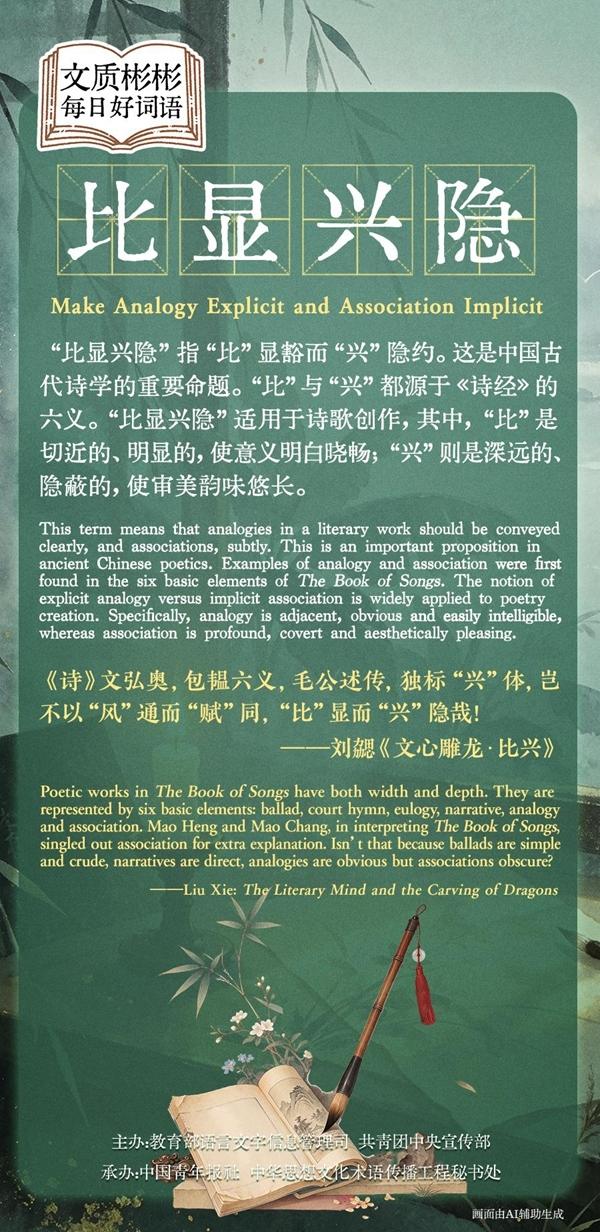
比显兴隐
“比显兴隐”指“比”显豁而“兴”隐约。这是中国古代诗学的重要命题。“比”与“兴”都源于《诗经》的六义。“比显兴隐”适用于诗歌创作,其中,“比”是切近的、明显的,使意义明白晓畅;“兴”则是深远的、隐蔽的,使审美韵味悠长。
Make Analogy Explicit and Association Implicit
This term means that analogies in a literary work should be conveyed clearly, and associations, subtly. This is an important proposition in ancient Chinese poetics. Examples of analogy and association were first found in the six basic elements of The Book of Songs. The notion of explicit analogy versus implicit association is widely applied to poetry creation. Specifically, analogy is adjacent, obvious and easily intelligible, whereas association is profound, covert and aesthetically pleasing.
引例
《诗》文弘奥,包韫六义,毛公述传,独标“兴”体,岂不以“风”通而“赋”同,“比”显而“兴”隐哉!(刘勰《文心雕龙·比兴》)(《诗经》中的作品宏大深奥,包含风、雅、颂、赋、比、兴六义。毛亨、毛苌为《诗经》作传,唯独标注了“兴”。难道不是因为“风”意义晓畅而“赋”铺陈直接、“比”显豁而“兴”隐约吗?)
Poetic works in The Book of Songs have both width and depth. They are represented by six basic elements: ballad, court hymn, eulogy, narrative, analogy and association. Mao Heng and Mao Chang, in interpreting The Book of Songs, singled out association for extra explanation. Isn't that because ballads are simple and crude, narratives are direct, analogies are obvious but associations are obscure? (Liu Xie: The Literary Mind and the Carving of Dragons)
来源:中国青年报
2026年11月29日 01版


 京公网安备 11010102004843号