
文质彬彬·每日好词语|有我之境/无我之境
发稿时间:2026-10-08 06:50:00 来源: 中国青年报
整理/秦珍子 制图/李晗
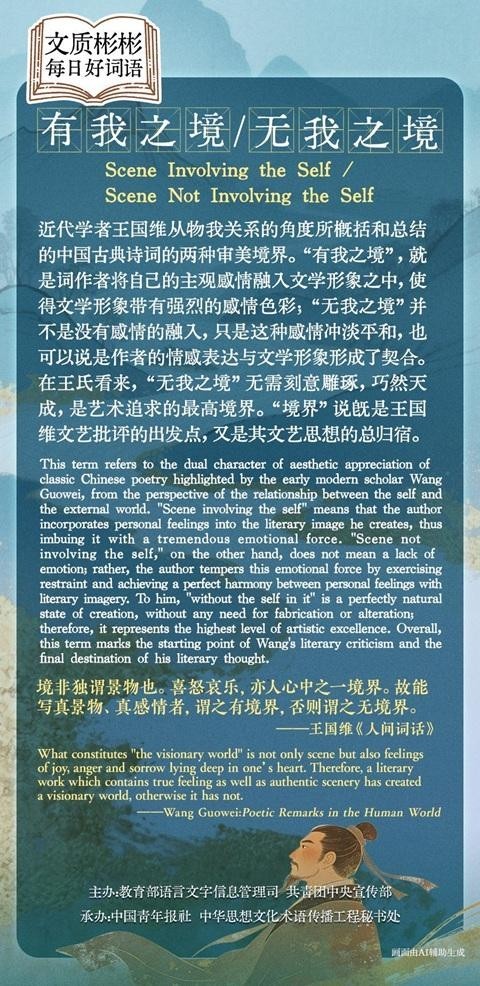
有我之境/无我之境
“有我之境”和“无我之境”是近代学者王国维从物我关系的角度所概括和总结的中国古典诗词的两种审美境界。“有我之境”,就是词作者将自己的主观感情融入文学形象之中,使得文学形象带有强烈的感情色彩;“无我之境”并不是没有感情的融入,只是这种感情冲淡平和,也可以说是作者的情感表达与文学形象形成了契合。在王国维看来,“无我之境”无需刻意雕琢,巧然天成,是艺术追求的最高境界。“境界”说既是王国维文艺批评的出发点,又是其文艺思想的总归宿。
Scene Involving the Self / Scene Not Involving the Self
This term refers to the dual character of aesthetic appreciation of classic Chinese poetry highlighted by the early modern scholar Wang Guowei, from the perspective of the relationship between the self and the external world. "Scene involving the self" means that the author incorporates personal feelings into the literary image he creates, thus imbuing it with a tremendous emotional force. "Scene not involving the self," on the other hand, does not mean a lack of emotion; rather, the author tempers this emotional force by exercising restraint and achieving a perfect harmony between personal feelings with literary imagery. To him, "without the self in it" is a perfectly natural state of creation, without any need for fabrication or alteration; therefore, it represents the highest level of artistic excellence. Overall, this term marks the starting point of Wang's literary criticism and the final destination of his literary thought.

来源:中国青年报
2026年10月08日 01版
-

中国
青年报 -

中青
看点 -

中青
校园 -

青创
头条


京ICP备13016345号-8 |  京公网安备 11010102004843号|24小时违法和不良信息举报电话:010-64098588
互联网新闻信息服务许可证10120170007号 |增值电信业务经营许可证A2.B1-20232628/京B2-20224905号|信息网络传播视听节目许可证0105108号
共青团中央主办 中国青年报主管 中青网新媒体科技(北京)有限公司版权所有