
文质彬彬·每日好词语 | 愚公移山
发稿时间:2026-09-18 06:06:00 来源: 中国青年报
整理/张渺 制图/董怡璇
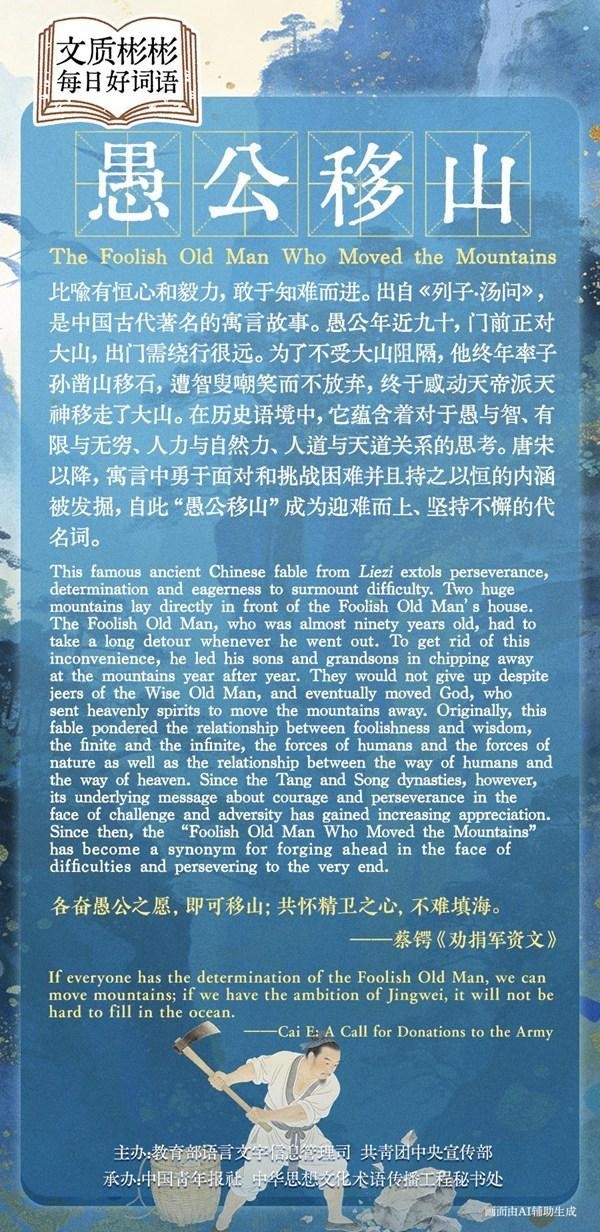
愚公移山
比喻有恒心和毅力,敢于知难而进。出自《列子·汤问》,是中国古代著名的寓言故事。愚公年近九十,门前正对大山,出门需绕行很远。为了不受大山阻隔,他终年率子孙凿山移石,遭智叟嘲笑而不放弃,终于感动天帝派天神移走了大山。在历史语境中,它蕴含着对于愚与智、有限与无穷、人力与自然力、人道与天道关系的思考。唐宋以降,寓言中勇于面对和挑战困难并且持之以恒的内涵被发掘,自此“愚公移山”成为迎难而上、坚持不懈的代名词。
The Foolish Old Man Who Moved the Mountains
This famous ancient Chinese fable from Liezi extols perseverance, determination and eagerness to surmount difficulty. Two huge mountains lay directly in front of the Foolish Old Man's house. The Foolish Old Man, who was almost ninety years old, had to take a long detour whenever he went out. To get rid of this inconvenience, he led his sons and grandsons to chip away at the mountains year after year. They would not give up despite jeers from the Wise Old Man, and eventually moved God, who sent heavenly spirits to move the mountains away. Originally, this fable pondered the relationship between foolishness and wisdom, the finite and the infinite, the forces of humans and the forces of nature as well as the relationship between the way of humans and the way of heaven. Since the Tang and Song dynasties, however, its underlying message about courage and perseverance in the face of challenge and adversity has gained increasing appreciation. Since then, the "Foolish Old Man Who Moved the Mountains" has become a synonym for forging ahead in the face of difficulties and persevering to the very end.
引例
各奋愚公之愿,即可移山;共怀精卫之心,不难填海。(蔡锷《劝捐军资文》)(大家如果都立下愚公那样的志向,就可以搬走大山;人们都怀抱精卫那样的雄心,填平大海也不再困难。)
If everyone has the determination of the Foolish Old Man, we can move mountains; if we have the ambition of Jingwei, it will not be hard to fill in the ocean. (Cai E, A Call for Donations to the Army)
张渺 董怡璇 来源:中国青年报
2026年09月18日 01版
-

中国
青年报 -

中青
看点 -

中青
校园 -

青创
头条


京ICP备13016345号-8 |  京公网安备 11010102004843号|24小时违法和不良信息举报电话:010-64098588
互联网新闻信息服务许可证10120170007号 |增值电信业务经营许可证A2.B1-20232628/京B2-20224905号|信息网络传播视听节目许可证0105108号
共青团中央主办 中国青年报主管 中青网新媒体科技(北京)有限公司版权所有