
文质彬彬·每日好词语|独乐其志,不厌其道
发稿时间:2026-07-31 06:27:00 来源: 中国青年报
整理/秦珍子 制图/李晗 张鲁沙(实习生)
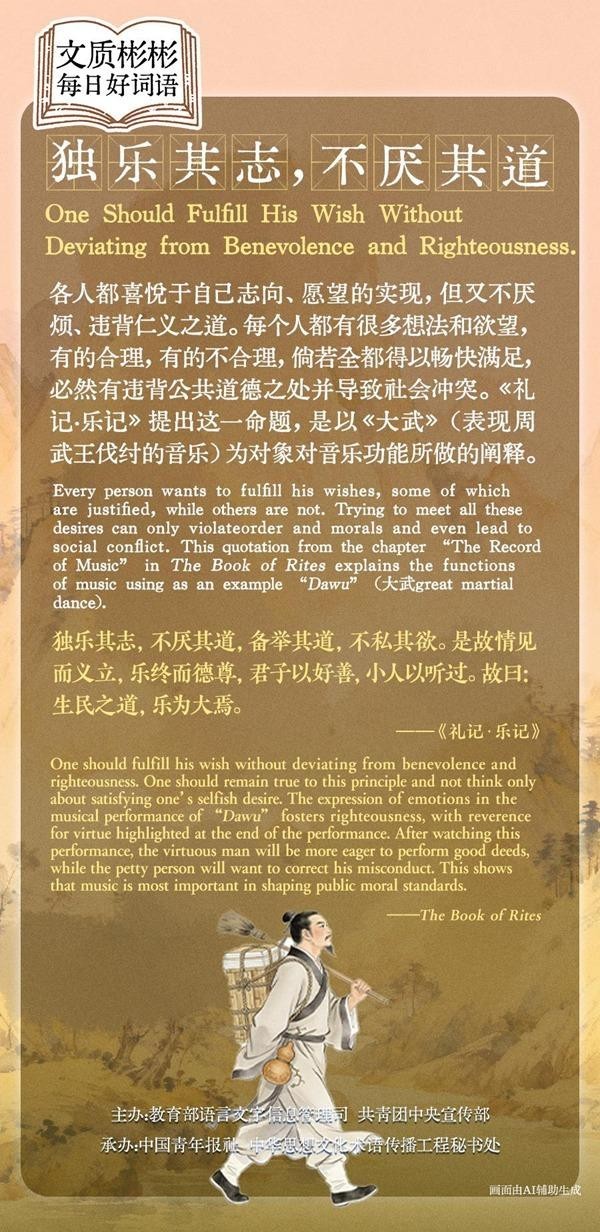
独乐其志,不厌其道
各人都喜悦于自己志向、愿望的实现,但又不厌烦、违背仁义之道。每个人都有很多想法和欲望,有的合理,有的不合理,倘若全都得以畅快满足,必然有违背公共道德之处并导致社会冲突。《礼记·乐记》提出这一命题,是以《大武》(表现周武王伐纣的音乐)为对象对音乐功能所做的阐释。周武王伸张了自己的志向,但他的行为并不是为了满足个人私欲,而是为了天下黎民铲除暴君,施行仁义之道,重建太平盛世。故《大武》的演奏,可以鼓舞君子向善,劝勉小人反思,起到很好的教化作用。
One Should Fulfill His Wish Without Deviating from Benevolence and Righteousness
Every person wants to fulfill his wishes, some of which are justified, while others are not. Trying to meet all these desires can only violate order and morals and even lead to social conflict. This quotation from the chapter "The Record of Music" in The Book of Rites explains the functions of music using as an example "Dawu". King Wu of Zhou won the victory. However, he had waged war not to achieve personal ambition but to overthrow a brutal despot in the interest of the people, to achieve benevolence and righteousness and restore peace and prosperity. Therefore, the performance of "Dawu" fostered public moral standard by encouraging people to be virtuous and reject undesirable behavior.
引例独乐其志,不厌其道,备举其道,不私其欲。是故情见而义立,乐终而德尊,君子以好善,小人以听过。故曰:生民之道,乐为大焉。(《礼记·乐记》)(各人都喜悦于自己志向、愿望的实现,但又不厌烦、违背仁义之道,完全遵循仁义之道,而不满足于一己私欲。因此《大武》的音乐,随着感情的外露,听众内心的仁义也得以确立;随着音乐的终结,也显示了对高尚德行的尊崇,君子听了喜好善行,小人听了反思过错。因此说:教养民众的方法,以音乐最为重要。)
One should fulfill his wish without deviating from benevolence and righteousness. One should remain true to this principle and not think only about satisfying one's selfish desire. The expression of emotions in the musical performance of "Dawu" fosters righteousness, with reverence for virtue highlighted at the end of the performance. After watching this performance, the virtuous man will be more eager to perform good deeds, while the petty person will want to correct his misconduct. This shows that music is most important in shaping public moral standards. (The Book of Rites)

来源:中国青年报
2026年07月31日 01版
-

中国
青年报 -

中青
看点 -

中青
校园 -

青创
头条


京ICP备13016345号-8 |  京公网安备 11010102004843号|24小时违法和不良信息举报电话:010-64098588
互联网新闻信息服务许可证10120170007号 |增值电信业务经营许可证A2.B1-20232628/京B2-20224905号|信息网络传播视听节目许可证0105108号
共青团中央主办 中国青年报主管 中青网新媒体科技(北京)有限公司版权所有