
文质彬彬·每日好词语|书者,散也
发稿时间:2026-07-05 06:43:00 来源: 中国青年报
整理/蒋肖斌 制图/张玉佳
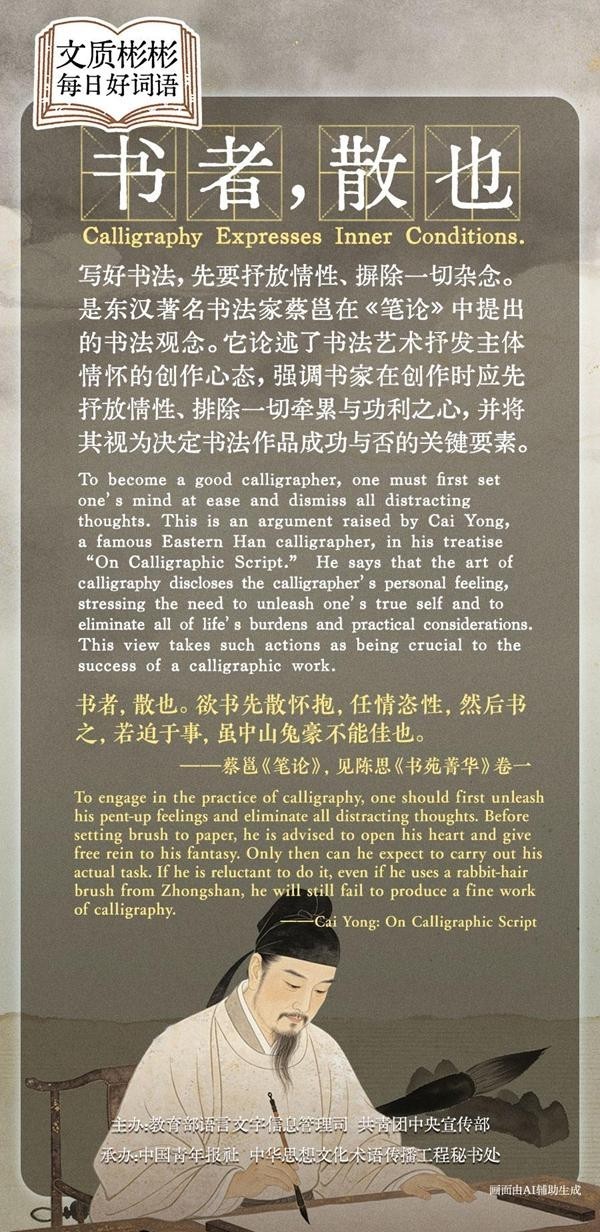
书者,散也
写好书法,先要抒放情性、摒除一切杂念。这是东汉著名书法家蔡邕在《笔论》中提出的书法观念。它论述了书法艺术抒发主体情怀的创作心态,强调书家在创作时应先抒放情性、排除一切牵累与功利之心,并将其视为决定书法作品成功与否的关键要素。
Calligraphy Expresses Inner Conditions
To become a good calligrapher, one must first set one's mind at ease and dismiss all distracting thoughts. This is an argument raised by Cai Yong, a famous Eastern Han calligrapher, in his treatise "On Calligraphic Script." He says that the art of calligraphy discloses the calligrapher's personal feeling, stressing the need to unleash one's true self and to eliminate all of life's burdens and practical considerations. This view takes such actions as being crucial to the success of a calligraphic work.
引 例
书者,散也。欲书先散怀抱,任情恣性,然后书之,若迫于事,虽中山兔豪不能佳也。(蔡邕《笔论》,见陈思《书苑菁华》卷一)(从事书法活动,先要抒放情性、排除一切杂念。动笔之前,必须舒展心胸,任凭性情恣意挥洒,然后再展毫书写,如果是被迫应事,即使是用中山兔毫佳笔,也写不出优美的书法作品来。)
To engage in the practice of calligraphy, one should first unleash his pent-up feelings and eliminate all distracting thoughts. Before setting brush to paper, he is advised to open his heart and give free rein to his fantasy. Only then can he expect to carry out his actual task. If he is reluctant to do it, even if he uses a rabbit-hair brush from Zhongshan, he will still fail to produce a fine work of calligraphy. (Cai Yong: On Calligraphic Script)
来源:中国青年报
2026年07月05日 01版
-

中国
青年报 -

中青
看点 -

中青
校园 -

青创
头条


京ICP备13016345号-8 |  京公网安备 11010102004843号|24小时违法和不良信息举报电话:010-64098588
互联网新闻信息服务许可证10120170007号 |增值电信业务经营许可证A2.B1-20232628/京B2-20224905号|信息网络传播视听节目许可证0105108号
共青团中央主办 中国青年报主管 中青网新媒体科技(北京)有限公司版权所有