
文质彬彬·每日好词语 | 童心
发稿时间:2026-06-02 06:22:00 来源: 中国青年报
整理/王璟瑄 制图/李晗 张鲁沙(实习生)
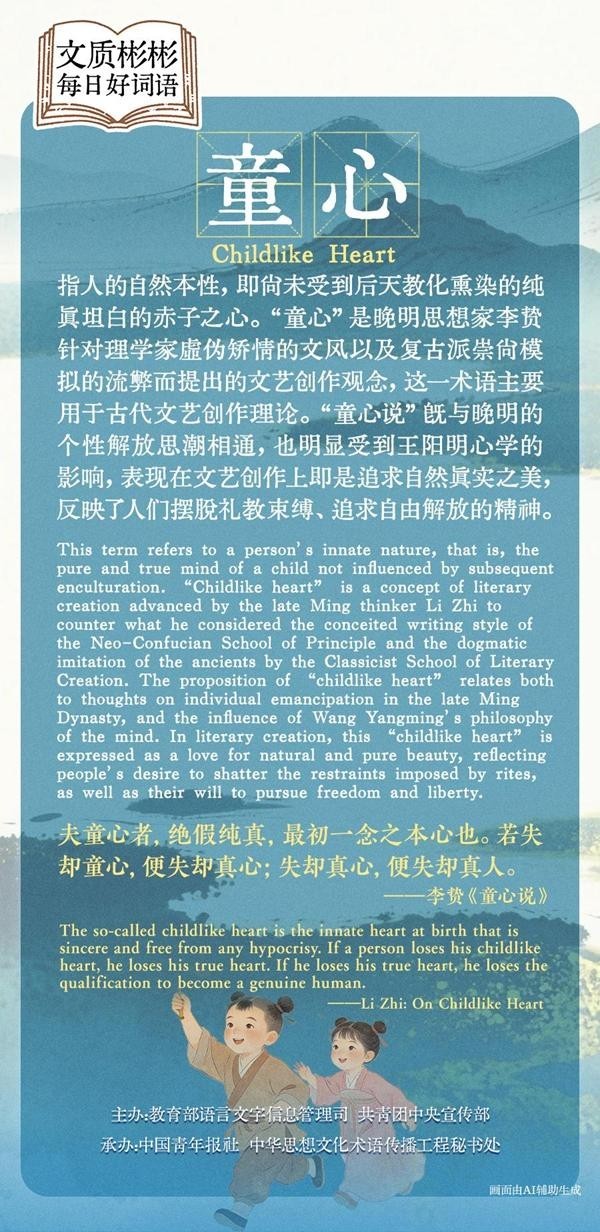
童心
指人的自然本性,即尚未受到后天教化熏染的纯真坦白的赤子之心。“童心”是晚明思想家李贽针对虚伪矫情的文风及复古派崇尚模拟的流弊而提出的文艺创作观念,这一术语主要用于古代文艺创作理论。“童心说”既与晚明的个性解放思潮相通,也明显受到王阳明心学的影响,表现在文艺创作上即是追求自然真实之美,反映了人们摆脱礼教束缚、追求自由解放的精神。
Childlike Heart
This term refers to a person's innate nature, that is, the pure and true mind of a child not influenced by subsequent enculturation. "Childlike heart" is a concept of literary creation advanced by the late Ming thinker Li Zhi to counter what he considered the conceited writing style and the dogmatic imitation of the ancients by the Classicist School of Literary Creation. The proposition of "childlike heart" relates both to thoughts on individual emancipation in the late Ming Dynasty, and the influence of Wang Yangming's philosophy of the mind. In literary creation, this "childlike heart" is expressed as a love for natural and pure beauty, reflecting people's desire to shatter the restraints imposed by rites, as well as their will to pursue freedom and liberty.
引例夫童心者,绝假纯真,最初一念之本心也。若失却童心,便失却真心;失却真心,便失却真人。(李贽《童心说》)(所谓童心,就是人生来就有的抛弃虚假、纯然真诚的本心。如果失去了童心,就会失去真心;失去真心,就会失去成为真诚之人的资格。)
The so-called childlike heart is the innate heart at birth that is sincere and free from any hypocrisy. If a person loses his childlike heart, he loses his true heart. If he loses his true heart, he loses the qualification to become a genuine human. (Li Zhi: On Childlike Heart)
来源:中国青年报
2026年06月02日 02版
-

中国
青年报 -

中青
看点 -

中青
校园 -

青创
头条


京ICP备13016345号-8 |  京公网安备 11010102004843号|24小时违法和不良信息举报电话:010-64098588
互联网新闻信息服务许可证10120170007号 |增值电信业务经营许可证A2.B1-20232628/京B2-20224905号|信息网络传播视听节目许可证0105108号
共青团中央主办 中国青年报主管 中青网新媒体科技(北京)有限公司版权所有