
文质彬彬·每日好词语 | 但见性情,不睹文字
发稿时间:2026-04-20 06:46:00 来源: 中国青年报
整理/李思 制图/董怡璇
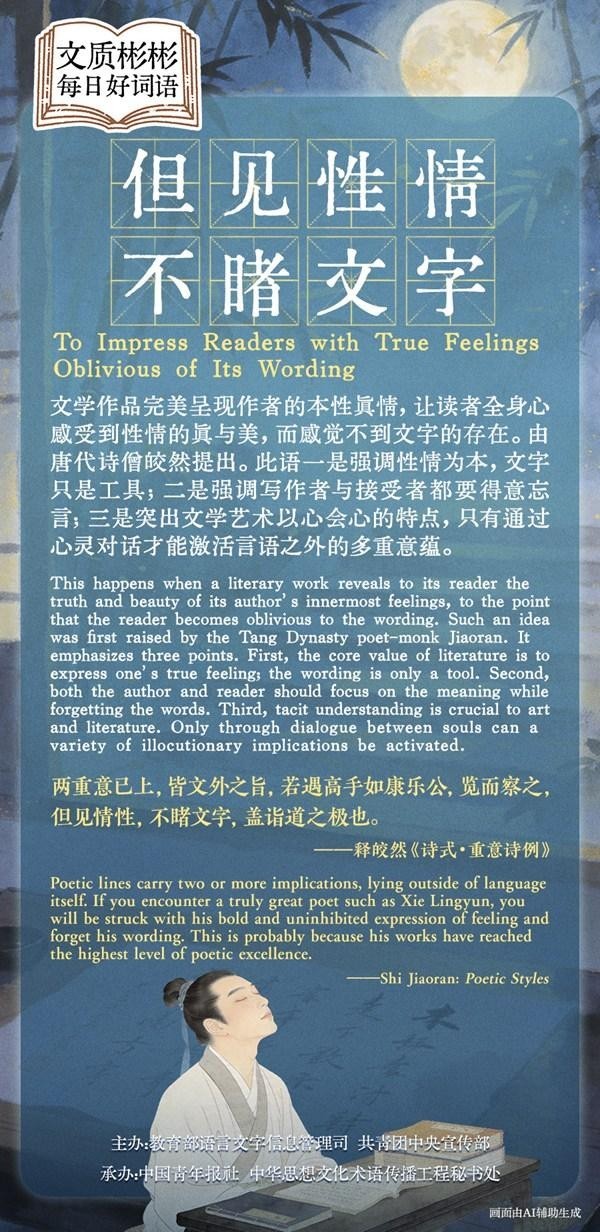
但见性情,不睹文字
文学作品完美呈现作者的本性真情,让读者全身心感受到性情的真与美,而感觉不到文字的存在。由唐代诗僧皎然提出。此语一是强调性情为本,文字只是工具;二是强调写作者与接受者都要得意忘言;三是突出文学艺术以心会心的特点,只有通过心灵对话才能激活言语之外的多重意蕴。
To Impress Readers with True Feelings Oblivious of Its Wording
This happens when a literary work reveals to its reader the truth and beauty of its author's innermost feelings, to the point that the reader becomes oblivious to the wording. Such an idea was first raised by the Tang Dynasty poet-monk Jiaoran. It emphasizes three points. First, the core value of literature is to express one's true feeling; the wording is only a tool. Second, both the author and reader should focus on the meaning while forgetting the words. Third, tacit understanding is crucial to art and literature. Only through dialogue between souls can a variety of illocutionary implications be activated.
引例两重意已上,皆文外之旨,若遇高手如康乐公,览而察之,但见情性,不睹文字,盖诣道之极也。(释皎然《诗式·重意诗例》)(诗句具有两重以上的意蕴,都属于言外之旨。如果碰到谢灵运这样的高人,仔细阅读他的作品,你会只感受到诗人的本真性情,不会注意他的文字,这大概是因为他的作品已经臻至诗歌创作的最高境界了。)
Poetic lines carry two or more implications, lying outside of language itself. If you encounter a truly great poet such as Xie Lingyun, you will be struck with his bold and uninhibited expression of feeling and forget his wording. This is probably because his works have reached the highest level of poetic excellence. (Shi Jiaoran: Poetic Styles)
来源:中国青年报
2026年04月20日 01版
-

中国
青年报 -

中青
看点 -

中青
校园 -

青创
头条


京ICP备13016345号-8 |  京公网安备 11010102004843号|24小时违法和不良信息举报电话:010-64098588
互联网新闻信息服务许可证10120170007号 |增值电信业务经营许可证A2.B1-20232628/京B2-20224905号|信息网络传播视听节目许可证0105108号
共青团中央主办 中国青年报主管 中青网新媒体科技(北京)有限公司版权所有