
文质彬彬·每日好词语|不平则鸣
发稿时间:2026-02-07 06:27:00 来源: 中国青年报
整理/秦珍子 制图/张玉佳
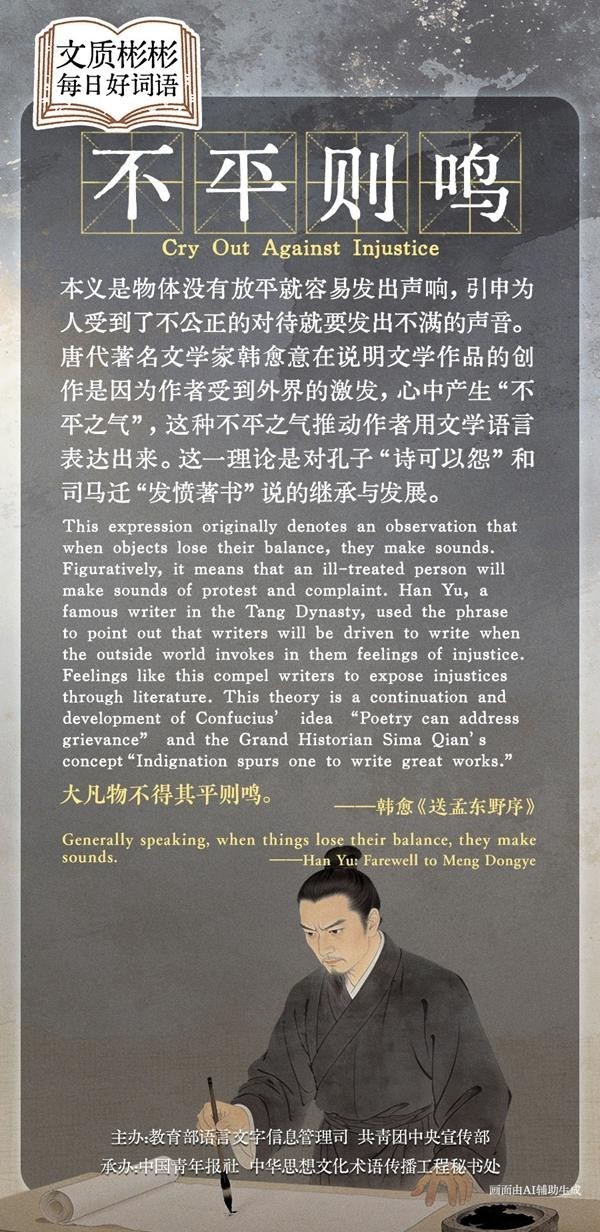
不平则鸣
本义是物体没有放平就容易发出声响,引申为人受到了不公正的对待就要发出不满的声音。唐代著名文学家韩愈意在说明文学作品的创作是因为作者受到外界的激发,心中产生“不平之气”,这种不平之气推动作者用文学语言表达出来。这一理论是对孔子“诗可以怨”和司马迁“发愤著书”说的继承与发展。
Cry Out Against Injustice
This expression originally denotes an observation that when objects lose their balance, they make sounds. Figuratively, it means that an ill-treated person will make sounds of protest and complaint. Han Yu, a famous writer in the Tang Dynasty, used the phrase to point out that writers will be driven to write when the outside world invokes in them feelings of injustice. Feelings like this compel writers to expose injustices through literature. This theory is a continuation and development of Confucius' idea "Poetry can address grievance" and the Grand Historian Sima Qian's concept "Indignation spurs one to write great works."
引例1大凡物不得其平则鸣。(韩愈《送孟东野序》)(一般来说,物体因为放置不平就容易发出声响。)
Generally speaking, when things lose their balance, they make sounds. (Han Yu: Farewell to Meng Dongye)
引例2 太史公曰:《说难》《孤愤》,贤圣发愤之所作也。由此观之,古之贤圣,不愤则不作矣。不愤而作,譬如不寒而颤,不病而呻吟也,虽作,何观乎?(李贽《<忠义水浒传>序》)(司马迁说:《说难》《孤愤》,是圣贤之人为抒发愤懑而写的作品。这样看来,古代的圣贤之人,没有愤懑的情绪是不会写作的。没有愤懑情绪的写作,就如同不寒冷却打寒颤,没生病却痛苦呻吟,即使写出来,又有什么值得看的呢?)
The Grand Historian Sima Qian said: "'On Difficulty' and 'Solitary Anger' are two pieces of writing by sages to give vent to their anger and frustration. Thus, it seems that ancient sages would not write if they were not angry and frustrated. To write without such emotions is to shiver without feeling cold, or to moan without being sick. Who would want to read such things even though they have been written?" (Li Zhi: Preface to The Outlaws of the Marsh)
来源:中国青年报
2026年02月07日 01版
-

中国
青年报 -

中青
看点 -

中青
校园 -

青创
头条


京ICP备13016345号-8 |  京公网安备 11010102004843号|24小时违法和不良信息举报电话:010-64098588
互联网新闻信息服务许可证10120170007号 |增值电信业务经营许可证A2.B1-20232628/京B2-20224905号|信息网络传播视听节目许可证0105108号
共青团中央主办 中国青年报主管 中青网新媒体科技(北京)有限公司版权所有