
文质彬彬·每日好词语|文武之道,一张一弛
发稿时间:2026-01-02 06:16:00 来源: 中国青年报
整理/李思 制图/李晗
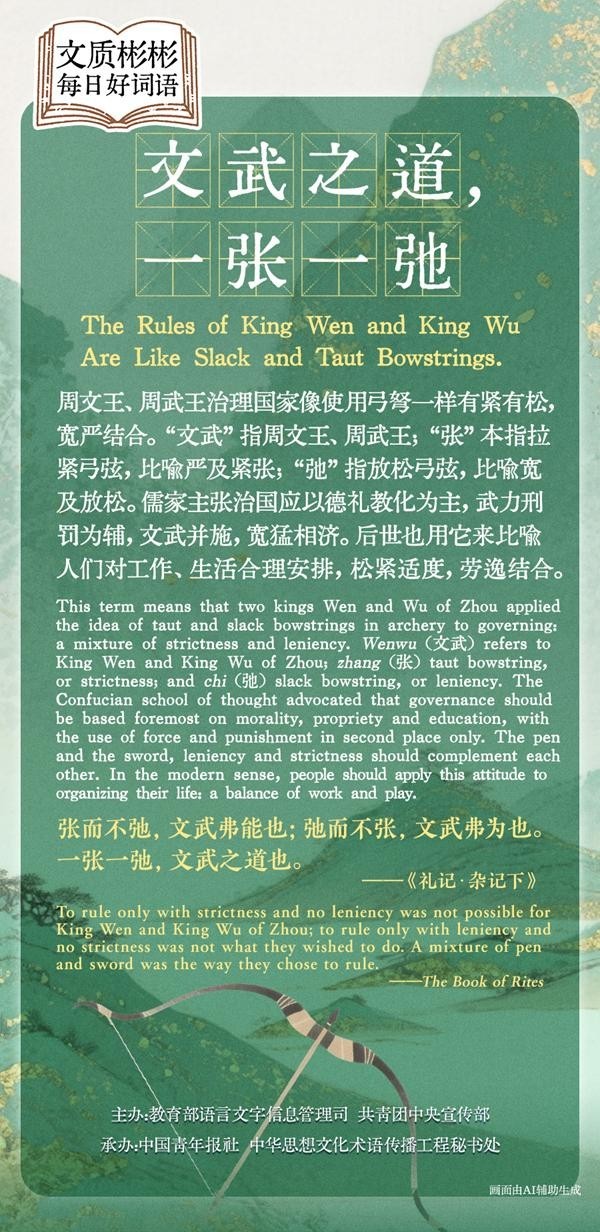
周文王、周武王治理国家像使用弓弩一样有紧有松,宽严结合。“文武”指周文王、周武王;“张”本指拉紧弓弦,比喻严及紧张;“弛”指放松弓弦,比喻宽及放松。儒家主张治国应以德礼教化为主,武力刑罚为辅,文武并施,宽猛相济。后世也用它来比喻人们对工作、生活合理安排,松紧适度,劳逸结合。
The Rules of King Wen and King Wu Are Like Slack and Taut Bowstrings.
This term means that two kings Wen and Wu of Zhou applied the idea of taut and slack bowstrings in archery to governing: a mixture of strictness and leniency. Wenwu refers to King Wen and King Wu of Zhou; zhang taut bowstring, or strictness; and chi slack bowstring, or leniency. The Confucian school of thought advocated that governance should be based foremost on morality, propriety and education, with the use of force and punishment in second place only. The pen and the sword, leniency and strictness should complement each other. In the modern sense, people should apply this attitude to organizing their life: a balance of work and play.
引例 张而不弛,文武弗能也;弛而不张,文武弗为也。一张一弛,文武之道也。(《礼记·杂记下》)(只紧张而不松弛,周文王、周武王不可能做到;只松弛而不紧张,周文王、周武王也不会这样做。宽严相济、张弛有度、劳逸结合,才是天下长治久安之道。)
To rule only with strictness and no leniency was not possible for King Wen and King Wu of Zhou; to rule only with leniency and no strictness was not what they wished to do. A mixture of pen and sword was the way they chose to rule. (The Book of Rites)
来源:中国青年报
2026年01月02日 01版
-

中国
青年报 -

中青
看点 -

中青
校园 -

青创
头条


京ICP备13016345号-8 |  京公网安备 11010102004843号|24小时违法和不良信息举报电话:010-64098588
互联网新闻信息服务许可证10120170007号 |增值电信业务经营许可证A2.B1-20232628/京B2-20224905号|信息网络传播视听节目许可证0105108号
共青团中央主办 中国青年报主管 中青网新媒体科技(北京)有限公司版权所有